What Belongs in a Pre-Employment Assessment Battery?
At CMA Global, we see it happen more often than most hiring teams would like to admit. A company adopts a fast, inexpensive personality quiz, checks the assessment box, and calls the hiring process rigorous. A real pre-employment assessment battery is something else entirely. A professional chooses a coordinated set of validated tools for the role, then combines and interprets them together. A single quiz cannot answer the question that matters: whether this specific person will succeed in this specific job.
A strong pre-employment assessment battery combines cognitive ability testing, structured interviews, and job-relevant work samples or simulations. A trained professional scores and interprets these together, not in isolation. No single tool predicts job performance reliably on its own. Combining several, matched to the role, gives you a more accurate and far more legally defensible picture of a candidate.
One Test Tells You Less Than You Think
One of our own consultants, Terence Bostic, has made the case for this elsewhere.
There’s a real difference between describing someone’s personality and predicting how they’ll perform in a specific role. A short questionnaire can show that a candidate is outgoing, detail-oriented, or calm under pressure, but what it can’t tell you is if they’ll hit their numbers. Nor does it show whether they can hold a warehouse team together through a bad shift.
The research backs this up more precisely than most hiring teams realize. A major 2022 reanalysis of decades of selection research, led by psychologist Paul Sackett, appeared in the Journal of Applied Psychology. It found that combining multiple assessment methods into a single battery lifts predictive validity well above what any single tool achieves alone. Some combinations reach a validity coefficient near .47 (Sackett, Zhang, Berry, & Lievens, 2022). A single personality inventory rarely gets close to that on its own. The lift comes from combining measures, not from finding one perfect test.
What Belongs in a Pre-Employment Assessment Battery
So what should be in one? The Society for Industrial and Organizational Psychology sets the standard the field holds itself to. Its Principles for the Validation and Use of Personnel Selection Procedures spell it out. In practice, a comprehensive battery usually includes four kinds of measures working together.
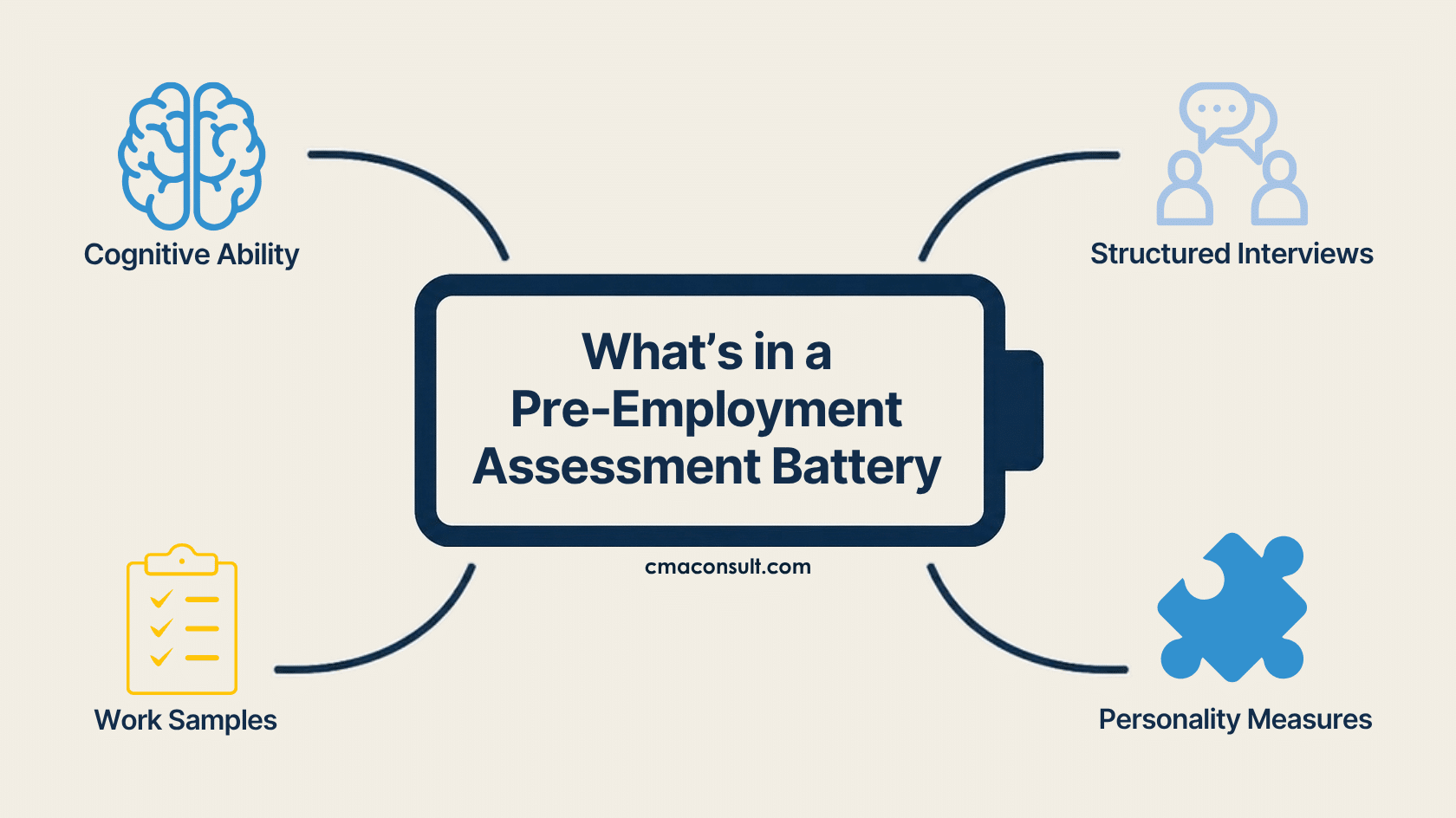
- Cognitive ability testing measures how a candidate reasons, learns, and solves problems. It remains one of the strongest general predictors of job performance across most roles.
- Structured interviews are not a casual conversation. They are a consistent set of job-relevant questions. Interviewers ask them the same way of every candidate and score them against a defined rubric. Structured interviews are among the most consistently validated tools in the field. They are also the piece most companies skip the structure on.
- Job simulations or work samples ask a candidate to do a piece of the job. That might be a sales role-play, a technical exercise, or a short case study. Watching someone do the work tends to predict performance better than asking them to describe how they would handle it.
- Validated personality or behavioral measures are useful, but only as one piece of the picture. This is where the fast, cheap tools tend to stop, and where a real battery keeps going.
None of these measures tells the whole story on its own. Put them together, and someone trained to weigh them against the role’s requirements can get you close.
Off-The-Shelf Platforms vs. A Battery Built for Your Roles
There’s a real market right now for quick, subscription-based assessment platforms. For some organizations, they are a reasonable starting point. But a platform built to serve thousands of companies at once is, by design, generic. A vendor didn’t design it around your roles or your culture. It doesn’t reflect the specific behaviors that separate a strong hire from a struggling one at your organization.
A custom-built battery starts from the job itself. What does success look like in this role, in this environment? Which measures will tell you something true about that, and which are noise? That is the work of an organizational psychologist, not a software subscription. It’s especially valuable for organizations hiring into roles where a bad fit is expensive to unwind. That might be a small business making a handful of critical hires a year, or a larger organization filling a specialized or leadership role.
This is the approach we take at CMA Global. Our Comprehensive Assessment pairs a battery of normed, validated questionnaires covering critical thinking, personality, motivation, and behavior with an interview conducted by a Ph.D.-level consultant. We don’t use AI to generate or interpret results. A trained expert reviews every assessment against the role and your organization’s culture.
It’s also worth knowing that the regulatory ground under automated, AI-scored hiring tools is shifting quickly. New York City’s Local Law 144 has required annual bias audits of automated employment decision tools since 2023. Several states have new requirements taking effect in 2026. None of this puts AI-scored tools off-limits. But it’s one more reason to work with people who understand both the psychology and the compliance landscape. A battery they design and review beats a tool built to move fast and worry about compliance later. This is a general overview, not legal advice. If your organization is evaluating AI-driven hiring tools, loop in counsel on what applies to you.
If you are building or re-evaluating your hiring process, this is where a proper assessment battery starts.
A Few Questions We Hear Often About This
What are the core components of a comprehensive pre-employment assessment battery?
A comprehensive battery typically combines cognitive ability testing, structured interviews, job simulations or work samples, and validated personality measures. Each measure captures something different, and no single one is sufficient on its own. Combine and interpret them together, and they give a far more accurate read on how a candidate will perform in the role.
How do pre-employment assessment batteries improve hiring decisions?
They replace guesswork with evidence. A battery replaces gut feel from an unstructured interview or a single quick test. It gives hiring teams several validated data points. You combine those points systematically, rather than leaning on any one alone. Research shows this multi-measure approach produces meaningfully higher predictive accuracy than any single assessment tool used alone.
What’s the difference between an off-the-shelf assessment platform and a custom battery?
A vendor builds an off-the-shelf platform to serve many companies at once, so it is generic by design. At CMA Global, we build a battery around your specific roles and pair it with an interview from a Ph.D.-level consultant, who interprets the results against your culture rather than generating an automated score. It takes more upfront work, and it produces a far more accurate and defensible result.
What does a pre-employment assessment battery typically cost?
It depends on the number of roles and the depth of the battery. It also depends on whether it draws on established tools or someone builds it fully custom. SHRM’s 2025 benchmarking data puts average cost-per-hire at $5,475 for nonexecutive roles. That number climbs fast once a hire doesn’t work out. A well-built battery is an investment against that larger cost, not an added expense on top of it.
Is a personality test alone enough to predict job performance?
No. A personality test can reasonably describe traits like extroversion or conscientiousness. Describing personality and predicting job performance are different things. Predicting performance takes measures tied directly to the demands of the role, like structured interviews and job simulations. Use those alongside personality data, not in place of it.
Hiring is one of the highest-stakes decisions any organization makes, and it deserves more than a fifteen-minute quiz. If you are rethinking how your organization evaluates candidates, we would welcome the conversation.
